
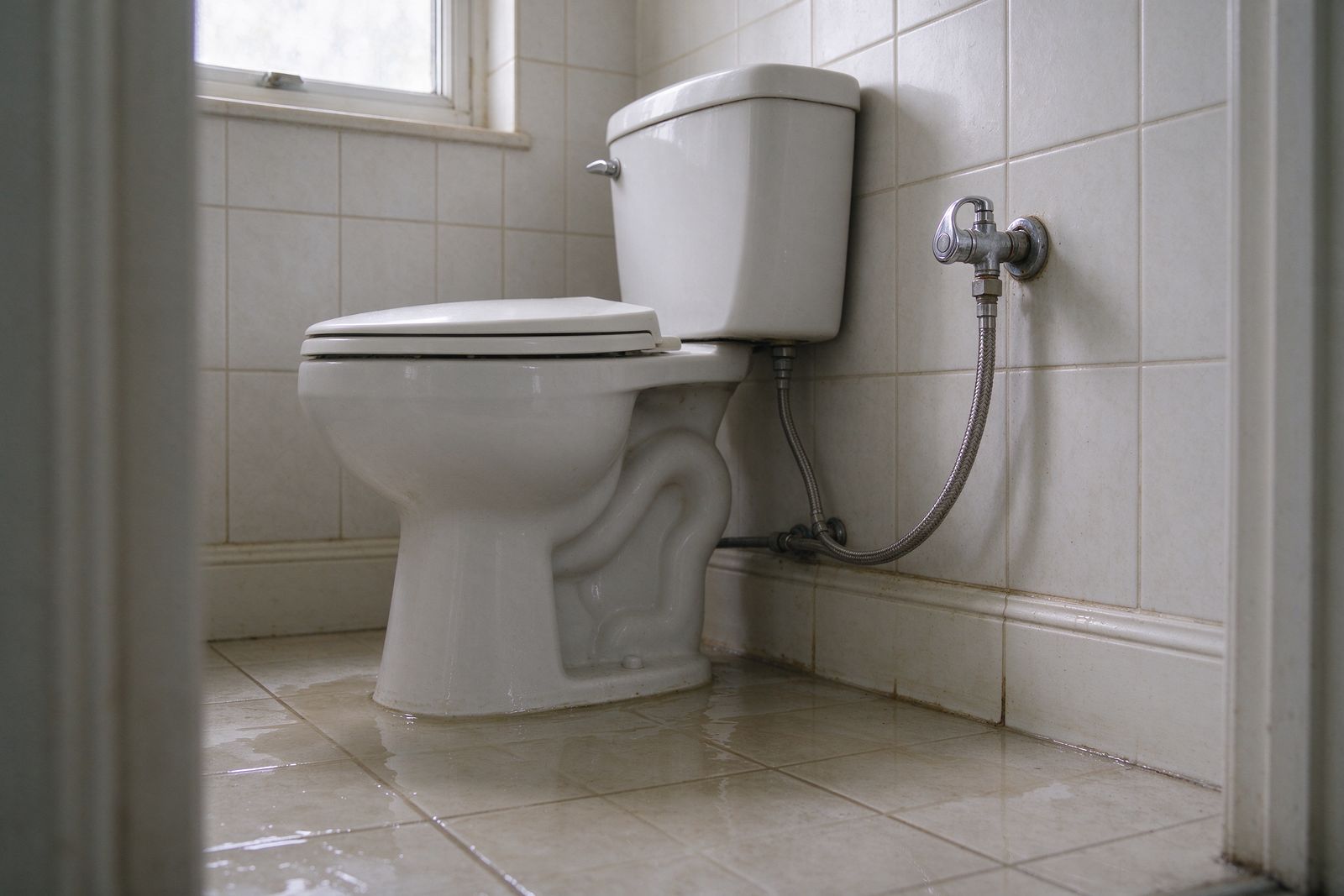
Stop the Bowl From Filling
- Close the stop valve behind the toilet. Turn the oval handle clockwise until it stops. The tank stops refilling and the bowl stops rising.
- If the valve is missing or seized, lift the tank lid and raise the float (a ball on an arm, or a cup on the fill valve). Holding it up shuts the fill. Then close the main.
- Do not flush again to "see if it clears." Each flush adds a full tank to a bowl that cannot drain.
- Lay towels and pick up water before it reaches the edge of the floor covering or a ceiling below.
Quick tell. If the toilet overflows but every other drain in the house runs normally, the clog is almost always in the toilet or its short branch line. That is a plunger or closet auger job and can often wait for regular hours.
Local Clog or Main Line Backup?
The lowest drains in a house are the first to show a main line problem, because everything you run flows down to them. Use what the other fixtures do as your diagnostic.
| Sign | Points to | Urgency |
|---|---|---|
| One toilet overflows, others fine | Local clog in that toilet | Usually can wait |
| Tub gurgles or rises when the toilet flushes | Blockage further down the shared line | Soon |
| Water or sewage at a basement floor drain | Main line or building sewer | Now |
| Several fixtures slow at once | Main line or vent issue | Soon to now |
| Backup after heavy rain | Overloaded public sewer or yard drainage | Now; contact the sewer utility too |
Sewer Backup: First Steps
- Stop all water use in the house. No flushing, showers, laundry, dishwasher or sink use. Tell everyone at home.
- Keep people and pets away from the affected area and close the door to it if you can.
- Do not use chemical drain openers on a main line backup. They rarely reach the blockage, can damage some pipes, and make the area more hazardous for whoever opens the line.
- Find the cleanout if you know where it is: a capped pipe, often in the basement floor, a crawlspace, or outside near the foundation. Do not open it yourself while sewage is backed up behind it; the contents come out under pressure.
- Photograph everything before cleanup, for insurance. Note that many standard homeowner policies treat sewer backup separately from other water damage; check yours, as covered in the insurance documentation guide.
The messy middle
Is it mine or the city's? Responsibility for the sewer line is usually split: the homeowner typically owns the building sewer from the house to the public main, and the utility owns the main. Exactly where that line falls varies by city. If neighbors are also backing up, or it started during heavy rain, call your local sewer utility as well as a plumber; a problem in the public main is theirs to fix.
Wastewater Safety Basics
Sewage carries bacteria and other pathogens. Treat anything it touched as contaminated until cleaned and disinfected.
- Wear waterproof gloves, boots and eye protection. Wash hands thoroughly afterward.
- Keep children, pregnant people, anyone with a weakened immune system, and pets out of the area.
- Porous items soaked by sewage (carpet pad, upholstered furniture, mattresses, cardboard) are often not salvageable. Photograph them before disposal.
- Larger backups are often handled by professional remediation companies. Your insurer may have requirements about who does the cleanup, so call them early.
Plunging a Toilet Without Making It Worse
Push gently on the first stroke to get the air out, then work in firm strokes while keeping the seal. When the water drops on its own, it has usually cleared. Refill the bowl by opening the stop valve a little and watch the level before flushing normally.
Who Handles What
A single clogged toilet is something many people handle themselves. Main line clearing, camera inspection of a sewer line, and repairs to the building sewer are typically done by licensed plumbers or drain specialists, and some require permits. The guide to choosing an emergency plumber covers the questions to ask, including whether a camera inspection is included or extra.